Research Project and Reading List

End Times, Eschatology, Prophecy
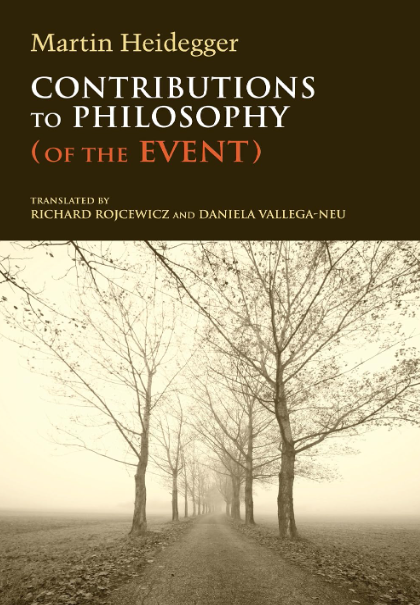
I have started a research project which traces the origin and development of the State throughout Western philosophy and a transformation of the concept of "the sacred" from the cosmos and the gods to being located in the State, what is called civil religion. This research project will inform the development of a book I'm titling End Times, Eschatology, Prophecy. The basis and inspiration for all this is Martin Heidegger's Contributions to Philosophy (Of the Event) (German: Beiträge zur Philosophie [Vom Ereignis]), composed privately between 1936 and 1938, but not available to the public until it was published in Germany in 1989. The material in that work which is the basis for this project concerns: developments on the history of being; the concept of "the last god;" the concept of abandonment by being; the development and machination of technology through enframing; "the second beginning" for metaphysics (nay, thinking); and Ereignis—"the event" of appropriation.

Summary and Abstract
Capitalism sits in a metaphysical history and tradition starting with the ancient Greeks, the opening of Western philosophy. Western philosophy, metaphysics, has developed in a trajectory of conceptions of objecthood, objectification, objectiveness, representation, substantiality, calculation, orderability, quantification, replicability, reason, rationality, mechanization, efficiency, and transaction. Through development and refinement of these ideas, philosophy is the mother of science. Science has developed technology, and technology has been able to further develop and refine science. This calculatory and ordering way of understanding being, in parallel, helped to develop capitalism.
The present age is characterized by an ultratechnological capitalism which more and more, and ever anew, seeks to enclose absolutely everything: from peoples and places to the earth and nature itself, exploiting, extracting, and surveilling everything in and under its power. Postindustrial, modern, and ultratechnological contemporary society has within itself a particular dialectical paradox: it is at the same time characterized by cultural richness, lucrative and high business, technological innovation, and social connection via the internet—and yet, we face an ever increasing police state through militarized police and brutalization and murder by ICE agents, extreme poverty and a poor quality of life, homelessness, low wages, brutal working conditions and hours, no healthcare, a diminishing quality of education, and an increasingly fascistic government that collaborates with white supremacist CEOs and tech oligarchs.
This mode of being, this way of understanding the earth as something to seize upon and exploit and extract resources and energy—that things come to stand as something to use up, what we call standing reserve—is a historical mode of being which is called enframing. Technology itself is a way of revealing—a way of en-framing nature as something to store up and use. The essence of technology in its way of revealing, disclosing, and unconcealing the meaning of being, in its interpretation of beings, is enframing.
Enframing is particularly dangerous because it is a predominant mode of disclosing, understanding, the world. It precludes any and all other ways of interpreting beings. It has a certain ontological hegemony, and it reinforces itself through its mechanization of everything. It conceals itself through efficiency and enormous, exponential growth (and waste).
Contemporary technological capitalism as a mode and development of enframing, in its destruction of the earth, all ecosystems, and peoples, is the most soulless age. As the most soulless, it is the most worldless age. The world has ceased to authentically be a world for us. There has been a transformation in humanity. We can no longer dwell together on the earth as its stewards. We have become fractured and alienated to each other. The present age can be said to be posthuman, something of an afterlife.
It has become necessary to reclaim our souls in their soulfulness. We must look beyond, after, capitalism and its operation in all States. We must prepare and make way for another beginning. As hinted in the title End Times, Eschatology, Prophecy, we must enter a meditation and reflection on this character of "the end" and "the prophetic" located within the destitution of the age itself. Is it merely the end here (and hereafter)? Has the end of history occurred? Is this hereafter a permanent posthuman afterlife? How might we think and will beyond it into a reclamation of our souls as stewards of the earth? Thinking beyond all States and capitalism is itself something "mad." It is madness to think of a destruction and reorganization of civilization itself. But the prophetic and the prophet appear as madness to a society that is already sick and mad. We must seek the beginning in and through the end.
One reason why this is "mad" and also terrifying and blasphemous and heretical is because the State and nation itself have become seen as the sacred and holy. The sacred and holy as the most sacred and holy. Nation and State are that which give the measure for meaning, belonging, holiness, reverence, and sacrality. Not seen as a source of exploitation, extraction, hierarchy, oppression, and unfreedom, it is seen as a gift and extension of god. This is called civil religion. Here too we must gather the traces of the prophetic.
But all this rests in a rethinking and reinterpretation of politics not as a theoretical study of government and economy, or thinking about what the best kind of government is, but thinking the political as that which is a fundamental way of being of the human being. Politics is originarily a way of dwelling and understanding the meaning of being. Politics is the way the human being lives, exists, on the earth in the company and community of its neighbors as stewards of the earth. Politics consists in that soulful and social way of dwelling on and with the earth, in preservation of its ecosystems, and in harvest of its abundance.
Form and Style
The style of the book is inspired by Rimbaud's Illuminations. It develops this idea of madness and insanity and explores them through hallucinatory and "psychotic" reflections—on the violence, death, suffering, and unworlding character of capitalism. But this madness and hallucinatory character is disclosive, revealing. It is intended to bring out the mad and "psychotic" that already lies within consumer capitalism. There are deep and recurrent themes within the whole project of sickness, madness, and hallucination. It must bring before us the question: what is the difference between the prophetic and the hallucinatory? What is the relation between madness and foresight (or better: farsight). Does the holy and the sacred rest on psychosis, madness, and the hallucinatory? We think ourselves as dreamers, but what guides the dreamer but the dream? Cloudy and lofty dreams—they are high above the ground; they are groundless. But we must be groundless and naïve to be able to dream—what is possible and what seems to be impossible.
Reading List
The books which will inform and shape the development of this work:
- The Republic: Plato
- The Politics: Aristotle
- The Prison Notebooks: Gramsci
- Leviathan: Hobbes
- Discourse on Inequality: Rousseau
- Discourse on Political Economy: Rousseau
- The Social Contract: Rousseau
- Burke and the Critique of Political Radicalism: Michael Freeman
- Dialectic of Enlightenment: Horkheimer, Adorno
- One Dimensional Man: Marcuse
- Society of the Spectacle: Debourd